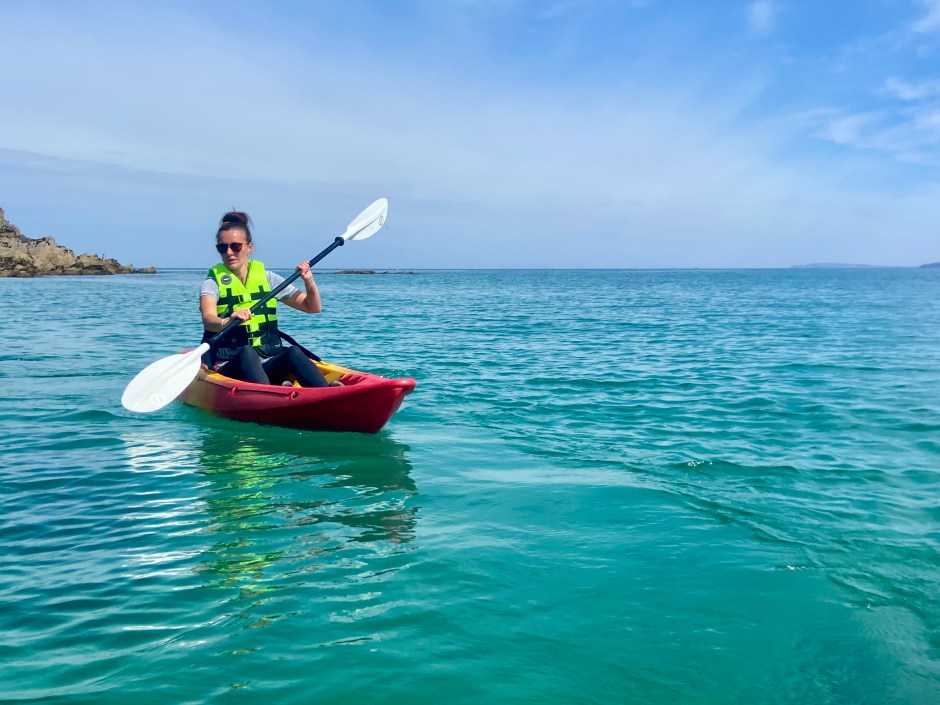
Our guide to the best places to SUP around Newquay covers the water most people start on: the Gannel at high tide, the harbour, Porth. A kayak opens up a slightly different map. You sit lower, you carry more, and you can cover several miles in an afternoon, which means some of the best trips in Cornwall might start outside Newquay altogether.
It also means a few more rules. Some of the water around here is managed by harbour commissioners, some by a lakes trust, and the paperwork is easy to miss until someone asks you for it on the slipway.
Again, like with paddleboarding, Newquay is on the north coast of Cornwall and renowned for being the surf capital of the UK, meaning lots of waves!
It can be very windy and bumpy seas in Newquay, so it’s not always the best conditions for kayaking on the sea. Though there are some calm days without waves or calmer seas further back from the shore, there is also the river Gannel which is fun for a leisurely paddle when the conditions and tide times are right.
As well as checking the tide times and how calm the sea is before you head out kayaking, here is what else is worth knowing before you load the car.
The Gannel Estuary
Still the obvious place to start, and the tide advice in the SUP guide holds for a kayak: the estuary is only worth paddling around high water, and not every high tide is high enough. In a kayak you will notice the shallow patches slightly later than on a board, but the estuary still empties, and the walk back across the mud is not one you want.
The same two access points work for a kayak, the slip off Trevean Way and the small car park on Gannel Road, although a trolley makes the carry easier. Note the 1.8m height barrier in the high season in the car park if you have roof bars fitted.
Crantock, at the mouth, deserves the same caution for kayakers as for paddleboarders. The National Trust is direct about it: the river creates currents that can be dangerous at certain stages of the tide, and the lifeguards will advise you to stay clear of the flow. It’s also worth noting that the river path can change, so it’s not always predictable. Lifeguard cover at Crantock Beach ran from 2 May to 27 September this year, 10am to 6pm.
Newquay Harbour
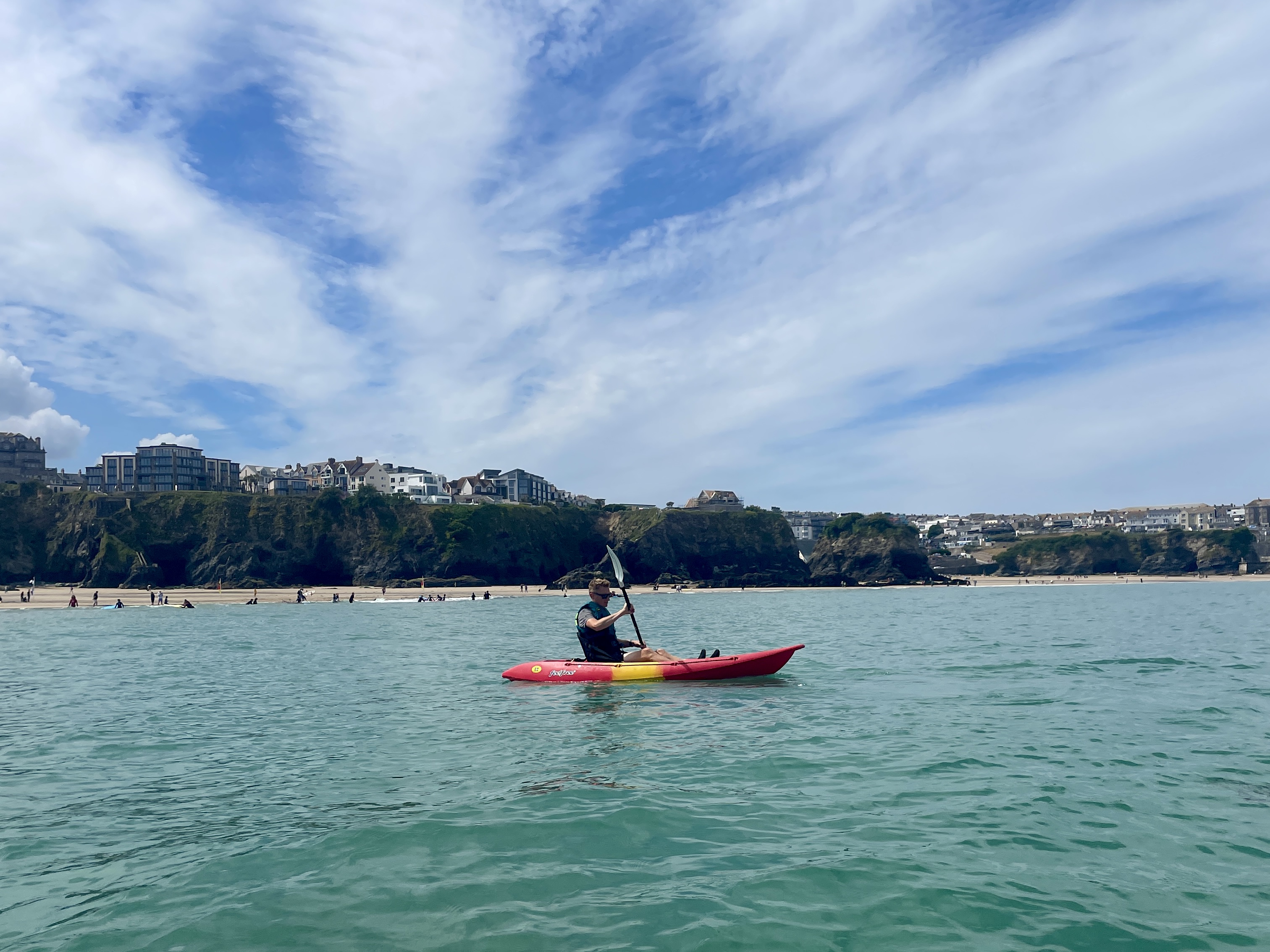
The harbour is the calmest water in town and the easiest place to get used to a boat. It is also a working harbour with its own byelaws, and this is the bit most visitors do not realise: under byelaw 12, vessels are not to be launched without the prior written consent of the harbour master, and the byelaws define a vessel as a ship, boat or raft of any description. That includes your kayak.
In practice it means a call or a visit to the harbour office first. Small craft are best launched from three hours either side of high water. For 2026/27 the published charges list a seasonal kayak fee of £120 for April to September, with day launching at £10 per small craft and trailer parking at £10 a day.
Not far from the harbour is Towan Headland, where, although you will need to pay for parking, there is an old lifeboat slope to the right hand side that you can launch off for free, especially if you can carry your kayaks down by hand – that’s what my husband and I did when we had our hard kayaks. As well as kayaking on the Gannel estuary, for the sea we started at Towan Headland and kayaked to Lusty Glaze or Porth Beach and back, when the sea wasn’t too choppy.
Padstow and the Camel, a little further north
A little further up the north coast from Newquay is the picturesque and quiet spot of Harbour Cove on the Camel estuary, just round from Padstow. It’s where we first tried a 2-in-1 SUP and kayak. It’s a bit of a walk from a carpark in a farmers field so was ideal for our 2-in-one boards which we carried on our back, but it was worth it once we got there. The beach was much quieter on this side.
It’s opposite Daymer Beach which is also at the mouth of the Camel estuary, and works as a good kayak spot for the same reasons, when the tide conditions are calm they have a car park close to the beach and the Camel at high tide on a calm day is perfect for exploring the coast. Again, check tide conditions before you arrive with your kayaks.
If you prefer to launch from Padstow Harbour itself, then there will be fees of £3 per kayak launch to pay to the harbour master. It’s also a really busy harbour, which is why we prefer to paddleboard or kayak nearer the mouth of the Camel estuary by starting at one of the beaches instead. Padstow Harbour Commissioners publish a port safety page with the byelaws, a byelaw map and a code of conduct for paddlecraft. Worth ten minutes before a first visit, particularly the channel entrance, which is busy with the foot ferry and fishing traffic.

Fowey, if you fancy a day out
Fowey is one of the nicest paddles in the county, and it has a registration scheme. The harbour commissioners require all kayaks, canoes and paddleboards to be registered before use on Fowey waters: £20 a year per boat, paddleboard or kayak with a visible sticker.
They are open about why, the upper estuary dries out fast on an ebbing tide and people end up stranded on the mud flats. They also don’t want to send out search operations for people whose craft has floated out to river if they are safe, so the QR code on the sticker lets them know who the craft belongs to.
The slipway at Caffa Mill is a public, council-owned ramp with no physical barriers or ticket booths. Because there isn’t a harbor warden standing there to collect cash on arrival, many kayakers roll up, launch their boats, and assume the experience is completely free. However, the moment you enter the water, you are legally subject to the Fowey Harbour Commissioners’ safety rules, which require all kayaks, canoes, and paddleboards to be registered under their £20 annual paddle sports scheme.
The reservoirs and lakes, when the coast is too windy
On a windy week, inland water is often the better call. Stithians and Siblyback are run by the South West Lakes Trust, and bringing your own boat requires a self-launch permit. A single-day permit costs £16 for one craft or £29 for two, which conveniently includes your parking. However, if you plan to go a lot, the annual unlimited launch membership offers much better value.
Starting around £190 per year, it covers free parking and unlimited access across all five South West Lakes sites: Stithians, Siblyback, Roadford, Tamar, and Wimbleball. You do need third-party liability insurance to cover accidental damage or injury to others, though most paddlers get this instantly by joining Paddle UK, which bundles it into their membership.
Finally, expect to sign a digital disclaimer before arrival, keep your buoyancy aid on at all times, and let the staff do a quick five-minute safety check on any inflatable craft before you launch.

Do you need a paddling licence?
On the sea, estuaries and tidal water, no.
A licence applies to the inland waterways managed by the Canal & River Trust and the Environment Agency, which is what a Paddle UK membership covers.
Some waterways have their own fees and licences such as Fowey’s which I mentioned above.
Harbour fees like Padstow and Newquay’s are separate and still apply – nearly all harbour’s will have a launch fee for their slipways.
Choosing a kayak you will actually take with you
If you are buying rather than hiring, the practical limits matter more than the marketing. A width of around 85cm is a sensible ceiling for a stable boat before it starts to feel slow. A two-person kayak under four metres will be tight once you account for leg room, and weight is the thing that decides whether the boat comes out on a Tuesday evening!
Under 15kg for a solo boat and under 18kg for a tandem is a reasonable target, and it is worth allowing about 25kg more payload than you think you need once bags and water are in. Most inflatables use PVC, with 1000 denier at the tougher end. Researching and reading a best inflatable kayak guide is a useful way to compare those numbers side by side before you commit.
Three inflation points with matching valves is the standard to look for. More chambers sound safer but mostly mean more pumping, and mismatched valve adaptors are a genuinely annoying way to start a morning.
Honestly, as we have had hard kayaks and mid-range inflatable 2-in-1-SUP-kayaks, I really prefer the convenience and lightweightness of the blow-up version. The hard kayaks felt cumbersome to me after being used to inflatable boards, but I can see how they’d be useful if you were getting close to rocks and wanted extra protection or a more durable material.
Also, inflatables don’t have such a long lifespan, but when we chose ours, we went for a slightly more expensive option that should have a lifespan of 10 years. Cheaper inflatables won’t last as long so it’s worth paying more for longevity and to be more eco-friendly.

Before you go kayaking in, or near, Newquay
Check the wind direction as well as the speed. The RNLI is clear that inflatables, including inflatable kayaks, are easily swept away from shore in an offshore breeze, so that is a day for a reservoir rather than the open coast.
Wear a buoyancy aid, keep a phone in a waterproof pouch and on you rather than in a dry bag in the boat, a whistle is also handy to attract attention if needed – hook one onto your buoyancy aid.
And, if you are unsure, ask the lifeguards for tips or advice, or whether conditions are safe to launch. In an emergency dial 999 and ask for the coastguard.
Discover more from Travel Vixta
Subscribe to get the latest posts sent to your email.